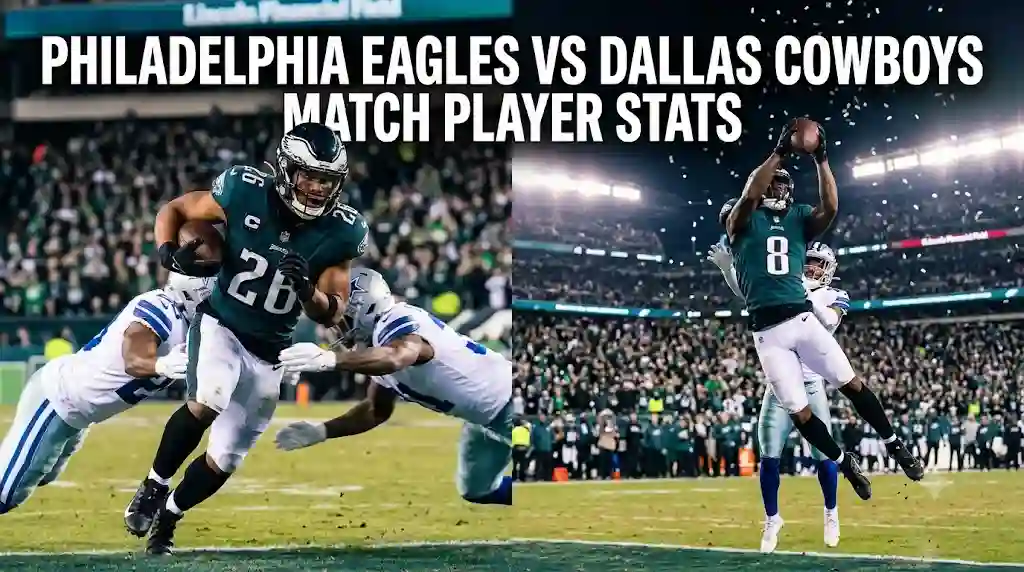
The philadelphia eagles vs dallas cowboys match player stats tell a brutal story of a one-sided rivalry game that turned into a Week 17 celebration for the NFC East champions. Jalen Hurts and the Philadelphia offense dismantled a depleted Cowboys squad 41-7 on December 29, 2024, at Lincoln Financial Field, securing the division crown with a performance that was even more lopsided than the final score suggested.
Philadelphia’s game plan exploited Dallas’s offensive limitations from the opening snap. By dominating time of possession and forcing four turnovers—including two interceptions returned for touchdowns—the Eagles turned a highly anticipated divisional clash into a victory lap. While the Eagles’ rushing game produced 148 yards, the defensive secondary feasted on backup quarterback Cooper Rush, limiting Dallas to a pitiful 5.2 yards per attempt.These player statistics provide a clear blueprint for how championship-caliber teams close out a regular season.
| Information | Match Details |
| Event | NFL Regular Season Week 17 |
| Game | Philadelphia Eagles vs Dallas Cowboys |
| Date | December 29, 2024 |
| Venue | Lincoln Financial Field, Philadelphia, PA |
| Attendance | 69,879 |
| Winner | Philadelphia Eagles |
| Final Score | Philadelphia 41 – Dallas 7 |
| Broadcast | FOX |
Core Match Statistics Overview
The statistical gap was a canyon. The Eagles maximized their red-zone trips and suffocated Dallas’s run game, holding the visitors to 39 total rushing yards. The turnover battle completely flipped the script, granting the Eagles short fields and defensive scores.
| Team Statistic | Philadelphia Eagles | Dallas Cowboys |
| Total Yards | 314 | 268 |
| Passing Yards | 166 | 229 |
| Rushing Yards | 148 | 39 |
| Turnovers | 0 | 4 |
| Time of Possession | 32:21 | 27:39 |
| Sacks | 3 | 1 |
| Third Down Efficiency | 7/13 | 4/12 |
Rushing Attack Disparity
The ability to run the ball with authority while simultaneously shutting down the opponent’s ground game defined the afternoon. The player stats show a physically dominant performance by the Eagles’ offensive line against a defense missing key personnel.
- Philadelphia averaged 4.5 yards per carry, led by Saquon Barkley’s explosive 167-yard outing, which consistently put the offense ahead of the chains.
- Dallas managed just 1.8 yards per attempt, forcing Cooper Rush into obvious, long-distance passing situations that played directly into Vic Fangio’s blitz packages.
Defensive Touchdown Surge
Dallas’s offense didn’t just fail to score; they actively gave points away. The Eagles’ defensive unit matched the offensive output in the first half, creating a statistical anomaly where quarterback pressure directly translated to six points.
- C.J. Gardner-Johnson capitalized on a miscommunication for a pick-six, rapidly deflating Dallas’s early momentum.
- The relentless interior push, even without generating a high sack total, forced the errant throws that allowed the secondary to secure 3 total interceptions.
Period-by-Period Analysis
The flow of the game shifted permanently after a costly Dallas fumble, with the Eagles mathematically eliminating any hope of a Cowboys comeback before halftime.
| Quarter | Philadelphia Eagles | Dallas Cowboys |
| 1st | 7 | 7 |
| 2nd | 17 | 0 |
| 3rd | 10 | 0 |
| 4th | 7 | 0 |
First Quarter: Dallas briefly matched intensity after a touchdown catch by Jalen Brooks. However, a fumble by returner KaVontae Turpin in the final seconds set up the Eagles at the Dallas 7-yard line.- Second Quarter: Hurts capitalized immediately with a “tush push” score, followed by Gardner-Johnson’s 69-yard interception return. The two-score swing in under two minutes turned a tight game into a statistical rout.
- Third Quarter: The Eagles drained the clock with a methodical 15-play drive, ending with another Hurts rushing touchdown. The player stats here reflect a total control of possession, limiting Dallas to just 6 offensive snaps in the entire quarter.
Philadelphia Eagles Player Statistics
The offensive stars aligned for career milestones, while the defensive front seven played a disciplined, gap-sound game.
Jalen Hurts (QB)
- Stats: 11/19, 115 Yds, 0 TD, 0 INT; 8 Rushes, 28 Yds, 2 TD
- Impact Summary: Rather than being explosive through the air, Hurts was brutally effective in the red zone. His physical rushing scores broke the franchise record for most rushing touchdowns by a quarterback in a single season.
Saquon Barkley (RB)
- Stats: 24 Rushes, 147 Yds, 0 TD; 2 Rec, 6 Yds
- Impact Summary: Barkley ran with a visible determination to hit the 2,000-yard mark, breaking off consistent chunk gains behind the left side of the line. Though he didn’t find the end zone, his yardage broke the Eagles’ single-season rushing record.
C.J. Gardner-Johnson (S)
- Stats: 4 Tackles, 2 INT, 1 TD
- Impact Summary: The vocal leader of the secondary executed a flawless read on a hitch route for his pick-six. His two interceptions were a direct result of diagnosing Dallas’s simplified route concepts instantly.
DeVonta Smith (WR)
- Stats: 4 Rec, 76 Yds, 1 TD
- Impact Summary: Smith’s deep over-route for a 49-yard gain was the most aesthetically pleasing play of the day. He showcased crisp route-running to create separation from the nickel corner despite the tight coverage.
Dallas Cowboys Player Statistics
The absence of CeeDee Lamb limited the offensive ceiling to almost zero, forcing tertiary receivers into primary roles they could not physically handle.
Cooper Rush (QB)
- Stats: 15/28, 147 Yds, 1 TD, 2 INT
- Impact Summary: Without a true perimeter threat, Rush was forced to hold the ball too long against zone blitzes. His day ended early after a hard hit, giving way to Trey Lance in garbage time.
Rico Dowdle (RB)
- Stats: 13 Rushes, 24 Yds, 0 TD
- Impact Summary: Dowdle found no daylight against the Eagles’ bear fronts. The low yardage output forced Dallas into a one-dimensional script, magnifying the talent gap on the offensive line.
Brandon Aubrey (K)
- Stats: 0/1 FG, Missed 49-Yard Attempt
- Impact Summary: Usually automatic, Aubrey pushed a long attempt wide left in the cold. The miss felt symbolic; even the league’s most consistent weapon was off the mark for Dallas.
Statistical Leaders Summary Table
The disparity in top-end production between the two rosters was stark, particularly in the run game and defensive big plays.
| Category | Philadelphia Eagles | Dallas Cowboys |
| Leading Scorer | Saquon Barkley (147 Yds) | Jalen Brooks (38 Yds) |
| Second Leading Scorer | DeVonta Smith (76 Yds) | Jake Ferguson (43 Yds) |
| Top Rebounder/Defense | C.J. Gardner-Johnson (2 INT) | Eric Kendricks (9 TKL) |
| Most Assists/Playmaker | Jalen Hurts (2 Rush TD) | Cooper Rush (1 Pass TD) |
Why the Eagles Won: Relentless Physicality
The Eagles didn’t win with trickery; they won by controlling the interior line of scrimmage. The philadelphia eagles vs dallas cowboys match player stats confirm a team hitting its physical prime in late December.
Methodical Ground-and-Pound Efficiency
Philadelphia’s identity is built on sustaining drives and wearing down defensive fronts. The back-to-back scoring drives of 13 and 15 plays effectively sucked the life out of the visiting sideline.
- Drives of 10+ Plays: Eagles 4, Cowboys 1
- Average Drive Time: Eagles 4:12, Cowboys 2:01
Lockdown Red Zone Defense
Bend-but-don’t-break became simply “don’t break.” Outside of a single blown coverage to Jalen Brooks, the Eagles’ secondary was glued to receivers when the field compressed.
- Dallas converted only 25% of their red zone trips, largely due to the tight coverage of rookie Quinyon Mitchell and the veteran instinct of Darius Slay erasing the sideline.
Why the Cowboys Lost: Lack of Offensive Firepower
Without a true WR1, the Cowboys’ offense was a blunt instrument trying to break through a reinforced wall. The player statistics highlight a scheme devoid of explosive playmakers.
One-Dimensional Passing Script
Mike McCarthy’s offense requires timing, but the Eagles’ press-man coverage disrupted routes beyond the five-yard mark. Rush’s average depth of target was a miserly 4.1 yards, indicating a lack of trust in the deep game.
- Yards After Catch: Cowboys 52, Eagles 116
- The inability to generate YAC meant every drive required 12-15 perfect plays, an impossibility against a defense that leads the league in forcing fumbles.
Self-Inflicted Wounds
Handing a divisional rival short fields is a death sentence. The Turpin fumble and subsequent interceptions transformed the Lincoln Financial Field crowd into a major factor.
- The four turnovers directly led to 24 Philadelphia points. Even one error destroys momentum in a rivalry game of size; four errors result in a historically poor stat line.
Historical Context & Advanced Insights
Season Series Breakdown
The 2024 series was a sweep for the Eagles, marked by a stark 75-13 aggregate scoring margin over the two games.
| Matchup | Date | Result | Key Stat |
| Week 10 (DAL) | Nov 10, 2024 | Eagles 34 – Cowboys 6 | Hurts 4 Total TDs |
| Week 17 (PHI) | Dec 29, 2024 | Eagles 41 – Cowboys 7 | 2 Defensive TDs |
Advanced Statistical Insights
The disparity in yards per play differential tells a complete story of superior coaching and execution. Philadelphia averaged 5.4 yards per play to Dallas’s 4.4. The most telling metric was the Passer Rating Differential. Hurts posted a solid 100.8 rating, while the combination of Rush and Trey Lance mustered a catastrophic 25.3 passer rating. This gap represents a near-total failure of the passing structure, directly correlating to the 14-point swing delivered by the Eagles’ defense.
Game Implications & Key Lessons
- What This Means for Philadelphia: Clinching the NFC East ensures at least two home playoff games, where Hurts has historically been nearly unbeatable. The rest for key starters in the fourth quarter minimizes injury risk ahead of a Super Bowl push.
- What This Means for Dallas: The loss solidifies a top-15 draft pick and exposes a stark talent deficit behind the starting skill players. The front office must address the backup quarterback and running back depth immediately.
- Key Lessons:
- Running the ball with a historic back controls the clock and crushes opponent morale.
- Defensive scoring correlates almost perfectly with victory margins in divisional games.
- Turnover margin isn’t just a stat; it’s the single predictor of coaching success.
- Third-down efficiency on the ground neutralizes elite pass rushers like Micah Parsons.
- Backup quarterbacks cannot function against zone-blitz concepts without a run game.
- Wrapping up tackles is a fundamental skill that prevents the kind of YAC Smith produced.
Frequently Asked Questions
Who won the Philadelphia Eagles vs Dallas Cowboys match?
The Philadelphia Eagles won decisively, defeating the Dallas Cowboys by a score of 41-7 on December 29, 2024.
What were Saquon Barkley’s exact stats in the game?
Barkley dominated with 147 rushing yards on 24 carries. He did not score a touchdown, but he broke the Eagles’ single-season franchise rushing record during the game.
How many interceptions did the Eagles defense record?
The Philadelphia secondary recorded 3 total interceptions. C.J. Gardner-Johnson grabbed two of them, returning one for a 69-yard touchdown.
What went wrong for the Dallas Cowboys?
Dallas collapsed due to an inability to run the ball and disastrous ball security. The Cowboys managed just 39 rushing yards and committed 4 turnovers, which directly led to 24 points for the Eagles.
What is the past record of these teams?
The Eagles swept the season series, bringing their all-time record to 8-3 in the last 11 meetings. This marked the most lopsided total victory margin in a season series for Philadelphia against the Cowboys.
This philadelphia eagles vs dallas cowboys match player stats breakdown highlights a championship formula built on defensive physicality and historic rushing records. The contrast in turnover margin and rushing success sealed a forgettable trip to Philadelphia for the Cowboys. As the Eagles march into the postseason, the efficiency of the roster’s complementary football—scoring on defense, controlling the clock on offense—makes them arguably the most dangerous team in the NFC.